Why sellers search for the best free tool to prepare for a business exit
If you are looking for the best free tool to prepare for a business exit, you are probably somewhere between "someday" and "maybe in the next two years" — and you know brokers, appraisers, and generic calculators each fail a different part of the job. Brokers want a mandate before they share methodology. Appraisers charge $50K–$200K for Quality of Earnings and deliver a static PDF weeks later. Calculators spit out a single multiple with no seller-weighted walk-away math. The best free tool to prepare for a business exit runs the same three institutional methods buyers underwrite — Free Cash Flow to the Firm, Free Cash Flow to Equity, and EV/EBITDA — blends them toward seller persona weighting, and stays live as you fix the discount drivers that determine whether you sell at the low or high end of your industry band.
Exit Matters Chapter 12 frames exit readiness as operational proof, not paperwork theater. Chapter 11 shows how owners who know their number negotiate from strength. Chapter 7 introduces the Blended View — three lenses weighted toward the decision in front of you. For sellers, that means more weight on what the market pays while FCFE keeps net debt and walk-away proceeds honest.
What exit preparation actually requires — beyond a single valuation
Seller-weighted blending. Buyers anchor on EV/EBITDA; you walk away with FCFE after debt, taxes, and structure. A tool that shows only enterprise value sets you up to accept a headline that leaves cash on the table.
Normalized earnings before multiples. Owner perks, one-time expenses, and working-capital anomalies get rebuilt in diligence. Start clean twelve months early so the range you rehearse matches the range a buyer rebuilds.
Discount driver prioritization. Owner dependency, customer concentration, earnings volatility, and capital intensity each compress your industry band. Rank fixes by blended delta per dollar and hour — that list is your pre-market operating plan.
Scenario rehearsal. Earn-out versus all-cash, working-capital pegs, seller notes, and timing ("fix then sell" versus "sell now") each change net proceeds. Model them before LOI, not during negotiation when emotion runs hot.
Living baseline. Exit preparation spans months. The tool must recalculate as books improve — not freeze a number from last quarter.
How XIT Matters supports sellers preparing to exit
XIT Matters implements the Exit Matters seller workflow as software — free during public beta, no credit card.
Six Persona Views include seller weighting that emphasizes EV/EBITDA while FCFE exposes walk-away math after net debt.
The Blended Valuation Engine combines FCFF, FCFE, and EV/EBITDA into one actionable seller headline plus supporting tiles.
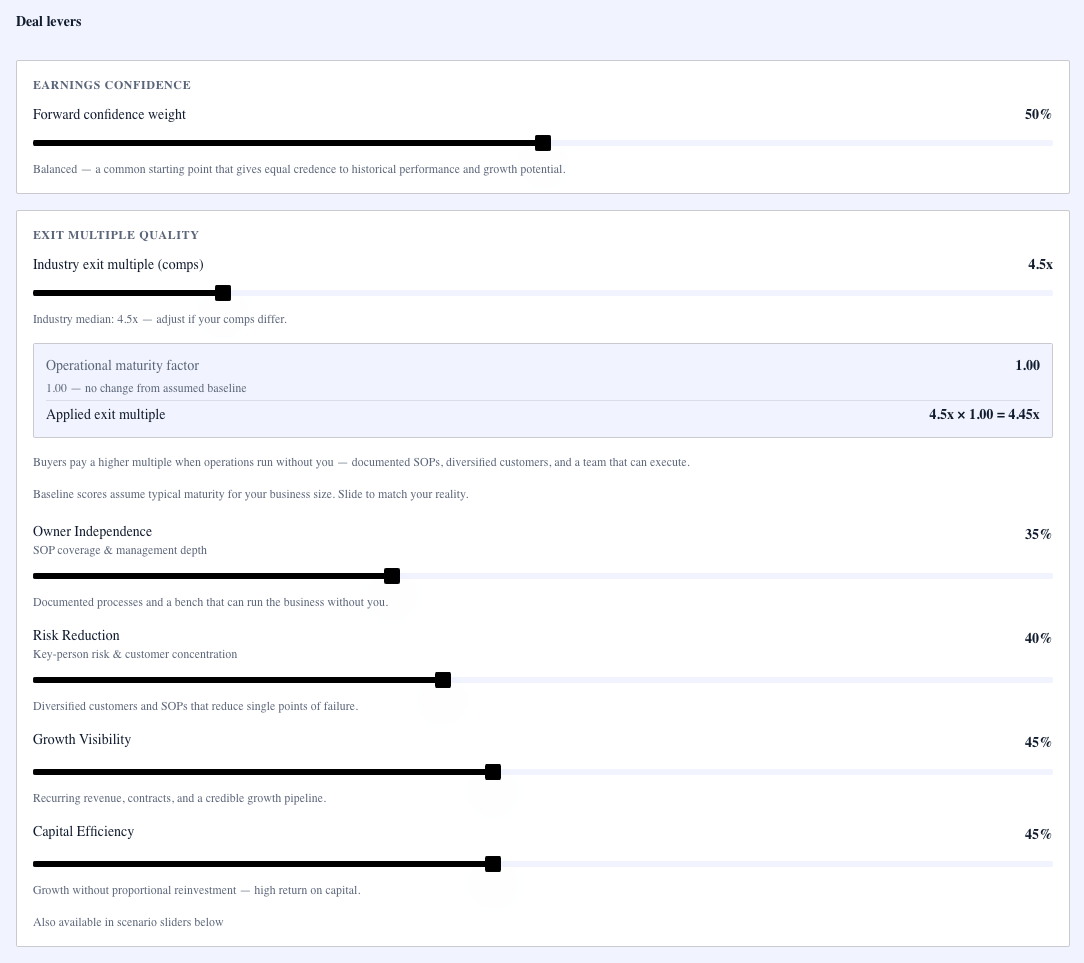
Real-Time Slider Modeling adjusts owner dependency, customer concentration, recurring revenue mix, and industry multiple band position — watch every method respond instantly.
The AI Scenario Analyst translates plain-English exit questions: "What if I deferred sale six months to reduce top-customer concentration from 35% to 22%?" — into coordinated lever moves and dollar deltas.
EV/EBITDA Market Comps anchor to real SMB transaction multiples for your industry with premium and discount drivers listed beside the slider.
Cost of Capital Simulator exposes WACC and cost of equity so capital-structure cleanup — debt paydown, lease normalization — flows through FCFF and FCFE, not just the debt line.
Approved trust claims: Built from Exit Matters, methodology used by PE firms, QuickBooks and Xero compatible, free during beta, ten minutes to your first valuation.
The twelve-month exit preparation playbook
Months 1–3: Baseline and honesty. Run seller-weighted valuation on current books. Identify the two largest discount drivers on your industry band. Share baseline with your CPA for normalization feedback — not a full QOE yet, just earnings quality direction.
Months 4–9: Fix and measure. Execute top-ranked operational fixes. Re-run valuation monthly; log blended delta. Document SOPs, reduce owner delivery hours, diversify customer base, clean working capital.
Months 10–12: Structure rehearsal. Model earn-out, seller note, and working-capital peg scenarios. Know your FCFE floor before broker conversations. Prepare one-page methodology summary for buyer diligence rooms.
Optional: Broker engagement. Arrive with range, fix log, and scenario outputs — brokers respect prepared sellers and often return better process terms.
Seller scenarios to model before LOI
Timing: sell now versus fix first. Compare seller-weighted blended value today against projected value after six or twelve months of documented fixes — net of execution risk and delay cost.
Structure: all-cash versus earn-out. Model FCFE under each structure; earn-outs often trade headline for risk — quantify the break-even.
Working-capital peg. Seasonal businesses get pegged hard in diligence. Scenario normalized working capital at close versus trailing average.
Debt payoff before sale. Refinancing or prepaying equipment debt changes FCFE walk-away — model before signing prep penalties.
Tax and transaction cost sensitivity. Not a full tax opinion — but directional FCFE after estimated net debt and rough transaction costs prevents headline chasing.
Common exit preparation mistakes sellers make
Waiting for perfect books. Start with good-enough normalized earnings and improve — waiting costs runway.
Optimizing enterprise value only. FCFE after net debt is what you deposit; ignore it at your peril.
Skipping scenario rehearsal. First LOI is not the time to learn earn-out math.
Announcing intent before internal range work. Know your floor privately first.
Treating free tools as binding appraisal substitutes. Use XIT for preparation; budget QOE when signing requires it.
Exit preparation versus Quality of Earnings — when each applies
Quality of Earnings and formal appraisal govern binding events — signed LOI diligence, litigation, IRS filings. They cost $50K–$200K and take weeks. Exit preparation software costs nothing during beta and takes ten minutes to start.
The 80/20 path: prepare with institutional methodology first, engage formal diligence when the deal requires it. Most sellers save $40K–$180K and months of blind waiting by quantifying range and fix priority before the first broker call.
How to evaluate exit preparation tools in ten minutes
Connect or enter two years of P&L and a balance sheet. Confirm seller persona weighting shifts the blend toward market comps. Verify FCFE shows net debt impact. Ask one exit scenario question — earn-out or timing — and confirm dollar deltas appear across methods. Change an owner-dependency input and watch the multiple band respond.
If the tool cannot do all of that, it is a calculator with exit marketing copy, not preparation software.
Negotiation advantage — knowing your range before they ask
Exit Matters Chapter 11 documents owners who walked into supplier, customer, and employee negotiations with blended value printed on one page — and shifted conversations from emotion to math. Sale negotiations work the same way. When you know your three-method range and can explain seller-weighted blending, buyers respect the preparation. The conversation moves from "what will you take?" to "here is the methodology behind my anchor."
The bottom line for sellers
The best free tool to prepare for a business exit runs seller-weighted FCFF, FCFE, and EV/EBITDA, models exit structures and timing scenarios, stays live as you fix discount drivers, and delivers walk-away FCFE math — not a single multiple guess. XIT Matters is free during public beta, ten minutes to first range, unlimited scenarios through your preparation window. Start now. Fix what moves the band. Arrive at the broker conversation with math instead of hope.
Employee and partner communication — using exit prep without oversharing
Exit preparation software helps you know your range privately before you announce intent. Use seller scenarios internally with your CPA, spouse, or silent partner — not with employees until process requires it. The discipline of monthly seller-weighted refresh builds confidence for the eventual conversation with your team without premature leakage that triggers key-person departures or customer anxiety. When you do engage a broker, your fix log and scenario archive demonstrate preparation that often shortens time-to-LOI because diligence rebuilds fewer surprises.
Tax-aware exit preparation — directional FCFE, not tax advice
Model walk-away FCFE directionally after estimated net debt and rough transaction costs — not as a substitute for tax counsel. Installment sale, asset versus stock structure, and state tax differences change net proceeds materially. Use the best free tool to prepare for a business exit as a compass for operational fixes and negotiation anchors; engage tax advisors before signing structure. The combination — operational preparation in XIT, structural advice from professionals — is how sophisticated sellers avoid optimizing enterprise value while leaving after-tax proceeds on the table.
Post-exit wealth planning starts before LOI
Seller persona FCFE scenarios clarify how much liquidity you need versus how much earn-out risk you can tolerate. Model required proceeds against personal balance sheet goals — debt-free home, retirement baseline, next venture seed capital — before buyers anchor low. Owners who skip this step accept structures that maximize headline enterprise value but fail personal financial goals. Exit preparation is not only about maximizing the business number; it is about maximizing what you keep and when you receive it.
Due diligence rehearsal — what buyers rebuild first
Buyers rebuild EBITDA, working capital, customer contracts, and owner dependency in that order. Use the best free tool to prepare for a business exit by pre-running each rebuild: normalized EBITDA worksheet, trailing working-capital average, concentration percentage, documented hours you still work in the business. When diligence asks for the same items, you respond with files already aligned to your seller-weighted model — not scrambling while LOI clock ticks. Preparation software does not replace diligence; it removes the shock when diligence matches what you already modeled.
Comparing exit prep tools — reject these patterns
Reject tools that quote enterprise value without FCFE walk-away. Reject static PDF outputs you cannot refresh monthly. Reject platforms that hide industry band drivers behind a single multiple. Reject exit calculators with no scenario engine for earn-out or timing. Reject anything that promises binding appraisal accuracy at $99. The best free tool to prepare for a business exit combines seller-weighted blending, live scenarios, and institutional methodology — the combination XIT Matters ships free during beta.
Your first week action list
Day one: connect or enter financials, run seller-weighted baseline. Day two: list top three discount drivers from your industry band. Day three: model one fix scenario per driver, rank by blended delta. Day four: share normalization questions with CPA. Day five: save outputs and schedule monthly refresh. Within one week you have more exit preparation complete than most owners accumulate in a year of broker phone calls without methodology.
Closing perspective for sellers
The best free tool to prepare for a business exit does not replace brokers, QOE, or tax counsel — it makes every downstream conversation cheaper, faster, and calmer because you already know your seller-weighted range, your fix priorities, and your scenario floors. XIT Matters is free during beta, ten minutes to start, unlimited refreshes through your preparation window. Sellers who start twelve months early rarely regret the time invested; sellers who start never wish they had waited longer.