Why the Best Free Business Valuation Tool 2026 Finally Matters to Real Owners
The phrase best free business valuation tool 2026 used to surface revenue-multiplier widgets that spat out a single guess based on last year’s top line. In 2026 that bar has moved. Owners who have sweated payroll, negotiated vendor terms, and stared at a 3 a.m. P&L want the same three institutional methods a professional appraiser would run — Free Cash Flow to the Firm, Free Cash Flow to Equity, and EV/EBITDA — then blended into one number that respects whether they are running the business today, prepping a sale in eighteen months, or weighing a growth loan. XIT Matters delivers exactly that stack, free during the public beta, no credit card required, and the full methodology stays available rather than locked behind a paywall.
Most owners still fly blind. They track profit and bank balance because those numbers arrive every month, but they miss the living valuation that turns every pricing tweak, hire, or equipment decision into a measurable move on the scoreboard that actually matters: what the business is worth right now and how that number compounds. The old free calculators stopped at a multiple. The serious ones now run the full discounted-cash-flow math, expose the cost-of-capital drivers, and let you test plain-English scenarios without building a spreadsheet from scratch.
The Three Institutional Methods That Separate Real Tools From Toys
A genuinely useful valuation engine must run all three methods professional appraisers rely on and show you how they diverge. That divergence is not noise — it is the signal.
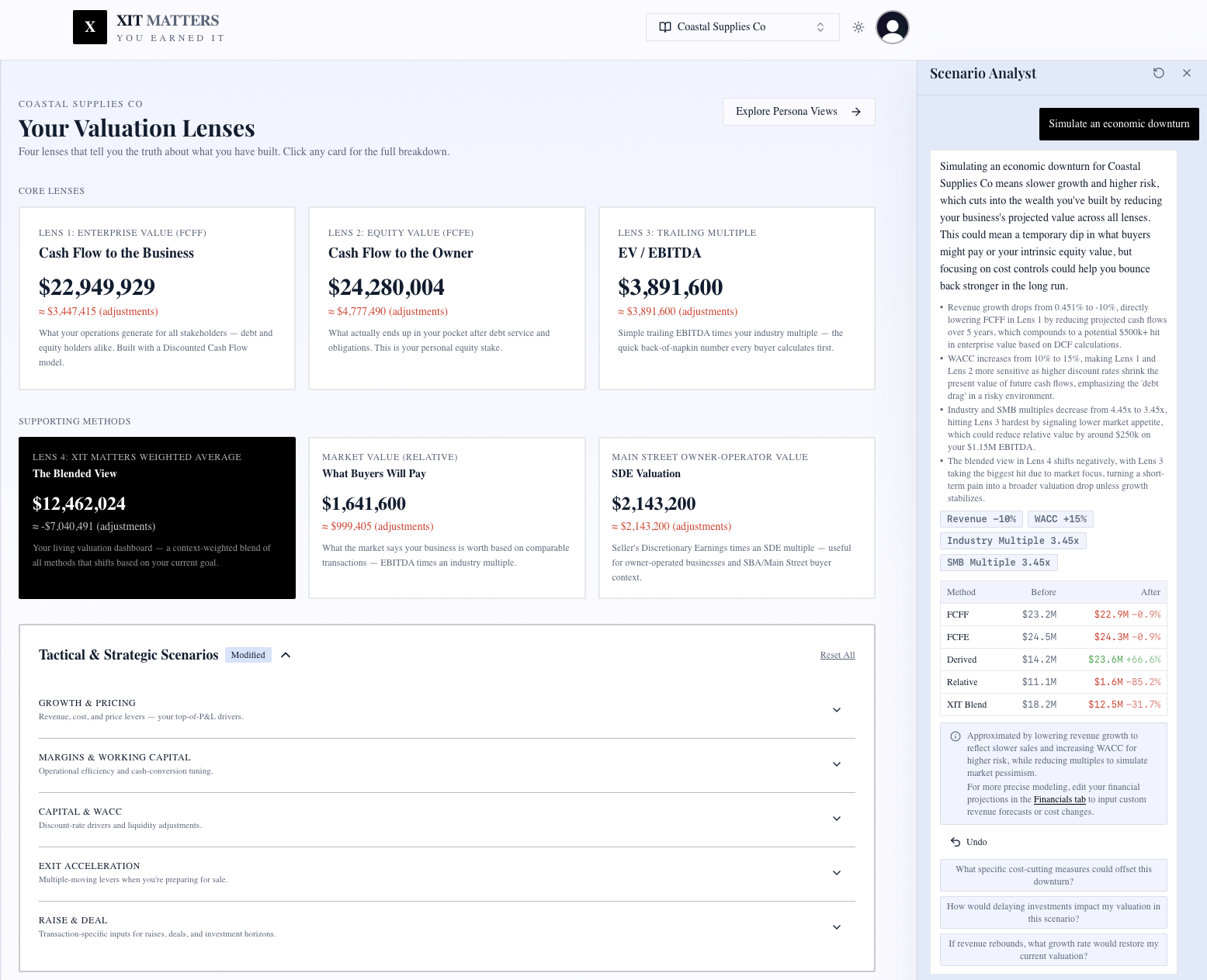
Free Cash Flow to the Firm (FCFF) measures what the entire operation generates for every stakeholder before financing decisions get in the way. Start with NOPAT (operating profit after tax but before interest), add back non-cash charges like depreciation, subtract reinvestment in equipment and working capital. Discount those future cash flows at your Weighted Average Cost of Capital. The result is Lens 1 — Enterprise Value — the raw horsepower of the business as if it had no debt. Owners often under-estimate this number because they focus only on what lands in their own pocket.
Free Cash Flow to Equity (FCFE) answers the more personal question: what cash actually reaches the owner after debt service, taxes, and the reinvestment required to keep the machine running. You can calculate it two equivalent ways. The intuitive route adds net borrowing to net income, adds back depreciation, and subtracts capital expenditures and working-capital growth. The capital-structure route recognizes that only the equity-funded portion of reinvestment reduces owner cash flow. Either path, discounted at the cost of equity (not WACC), produces Lens 2 — Equity Value. This is the number that funds your life, your kids’ college, or the down payment on the next venture.
EV/EBITDA captures what a buyer would actually write a check for today. It starts with your current or forward EBITDA and applies a multiple drawn from comparable transactions, then adjusts for the specific factors that make your business more or less attractive than the average — customer concentration, recurring revenue, owner dependence, growth trajectory, and capital intensity. That is Lens 3 — Market Value. It is the cold reality check that tells you whether the market already prices in strengths your cash-flow models have not yet captured.
XIT Matters runs the full stack in the background and surfaces the key cost-of-capital inputs so you can see why a two-point change in WACC swings enterprise value by six figures. Most generic calculators hide that math or force you to accept a default 12 % or 15 % that may be wrong for your risk profile and industry.
The Blended View — One Number That Matches Whatever You Are Actually Trying to Do
No single lens tells the whole truth. Mike, the composite Florida HVAC owner whose numbers appear throughout the framework, started with Lens 1 at $2.17 million, Lens 2 at $1.67 million, and Lens 3 at $2.70 million. Which number should he use to decide whether to raise prices, hire another tech, or lease versus buy a van? The answer depends on the decision in front of him.
That is why the framework adds Lens 4 — the Blended View. It is a context-weighted average of the three lenses that shifts the moment your goal changes. For day-to-day operations the default weights are 40 % Lens 1, 40 % Lens 2, 20 % Lens 3 because cash flow stability matters most while you are still running the business. Preparing to sell in the next year or two flips the weights to 20 / 20 / 60 so the market lens dominates. Raising growth capital weights Lens 2 more heavily to protect against dilution. Family succession tilts toward equity value so the transfer feels fair to the next generation.
Mike’s baseline day-to-day Blended View came in at roughly $2.04 million. Shift the same three numbers to a pre-sale mindset and the Blended View jumped to $2.39 million. Same business, different goal, different single number you can actually act on. The tool recalculates the blend instantly when you change context or when fresh financials flow in from QuickBooks or Xero. You stop arguing about which lens is “right” and start steering with the number that matches the conversation you are about to have with a spouse, a lender, or a potential buyer.
Why Generic Calculators and One-Multiple Tools Keep Owners Flying Blind
A revenue-multiple widget or a single EBITDA multiple calculator feels fast until you actually need to make a decision. It cannot tell you whether raising prices on your highest-margin service line will expand or contract your multiple because it never models the risk-reduction effect. It cannot show the five-year impact of hiring a $70k sales rep because it has no scenario engine. It ignores cost-of-capital sensitivity entirely. And it delivers the same answer whether you are operating day-to-day or preparing to sell in eighteen months.
The 2026 standard for owners doing serious work is the blended-method answer, not the multiplier guess. Institutional methods force you to confront reinvestment drag, working-capital cycles, and the real cost of the capital you already have tied up in the business. They expose the hidden lever — your WACC — that quietly adds or subtracts hundreds of thousands of dollars from every future cash flow. Generic tools skip all of that and leave you with a number that feels precise but cannot survive contact with a real decision.
AI Scenario Analyst Turns Plain-English Questions Into Precise Value Moves
The feature that separates the best free business valuation tool 2026 from everything else is the ability to ask “what if” in plain English and receive exact lever moves across all four lenses. Type “raise specialty product prices 4.5 % on my coastal accounts” and the engine translates that into higher revenue, protected margins, a modest multiple expansion from reduced buyer risk perception, and a net blended-value increase — all without you building a spreadsheet or guessing at second-order effects.
The same engine handles hiring decisions, capital-expenditure choices, and shifts in recurring-revenue mix. It surfaces the trade-offs: a new van might lift Lens 1 through lower maintenance but pressure Lens 2 in year one; converting top accounts to annual supply agreements might expand the multiple faster than any price increase. Owners who have used the scenario bar report that the first run rarely matches the final decision — they iterate, adjust assumptions, and watch the Blended View move in real time. That feedback loop turns valuation from a once-a-year event into a weekly management habit.
Real Decisions, Real Moves — How the Four Lenses Change What Owners Actually Do
Mike’s HVAC business was already profitable at $2.4 million revenue and $380k owner profit. Before he saw the four lenses he made reinvestment calls on gut feel and monthly bank balance. After he started scoring every move against Lens 1, Lens 2, Lens 3, and the Blended View, the pattern shifted. A 4 % price increase on service agreements added $145k to enterprise value and $118k to equity value in year one, with the market lens expanding even more because buyers reward pricing power. The same analysis showed that buying rather than leasing a new van added $92k to Lens 1 over five years while protecting Lens 2. A $70k service-tech hire looked negative in year one on cash flow but positive on the Blended View once forward revenue growth and multiple expansion were modeled.
Sandra at the composite coastal-supplies distributor faced a different fork: raise prices 4.5 % on specialty marine lines or spend $135k to add a sales rep and new territory. The scenario engine showed the price increase delivered $640k in enterprise value with zero capital outlay and no ramp risk, while the territory expansion required nine months to break even and carried execution risk. She chose the price move, documented the outcome three months later, and confirmed the model had been within 3 % of actual results. That is the power of institutional methods plus live scenario modeling: decisions that used to feel like coin flips now carry quantified upside and clear downside protection.
Ten Minutes to Your First Living Valuation — No Credit Card, No Gate
Getting started is deliberately lightweight. Create a free account, connect QuickBooks or Xero (or upload the last twelve months of P&L and balance-sheet summaries), and the engine produces the four lenses plus the default Blended View in roughly ten minutes. Manual entry takes about fifteen. From that moment the dashboard stays live: change any input and every lens and the blend recalculate instantly. Cost-of-capital assumptions surface in plain view so you can stress-test the risk-free rate, your industry beta, or your effective debt cost. The scenario bar sits at the top; type any question and watch the deltas appear across revenue, margins, reinvestment, multiple, and the final blended number.
Power-user features such as branded PDF exports and true two-way live sync remain in beta, but the core institutional stack — FCFF, FCFE, EV/EBITDA, cost-of-capital math, and plain-English scenario modeling — is fully available during the public beta. Beta users are grandfathered when paid plans launch, so the “free” period is not a ticking clock.
Your Financial Data Stays Private Even in a Free Tool
Bank-level encryption protects every upload. XIT Matters never sells data and never shares underlying numbers with third parties. You can delete your company at any time and the financial inputs disappear from the engine. The same privacy posture that serious owners demand from paid platforms is present on day one of the free tier. That matters when the alternative is emailing spreadsheets to a broker or uploading to a generic calculator whose data policy you cannot verify.
The 2026 Standard Is Blended Institutional Methods, Not Multiplier Guesses
A genuinely useful free tool in 2026 must clear a higher bar than the widgets of 2023. It must run all three institutional methods, expose the cost-of-capital math so you understand sensitivity, model scenarios in plain English rather than forcing you to build spreadsheets, stay honest about the 80/20 limits of any owner-driven valuation, and deliver a blended number that shifts with your actual goal. XIT Matters was built to that brief and remains free during the public beta precisely so owners can put the full stack to work without waiting for budget approval or a broker engagement.
The head-to-head comparison above makes the difference concrete. Traditional appraisers deliver the full methodological stack but at $50k–$200k per engagement and with no live scenario engine you can run every week. Generic calculators are cheap or free but stop at a single multiple and give you no visibility into cost of capital or context-weighted blending. XIT Matters sits in the only quadrant that combines institutional rigor, live scenario modeling, persona-aware blending, and zero upfront cost during beta.
If you have been managing on profit and bank balance alone, the shift to a living four-lens valuation changes the game faster than any single hire or price move. You finally see which decisions actually compound value and which ones quietly erode it. Ten minutes to the first answer, live updates forever after, and the full institutional stack available right now — that is what the best free business valuation tool 2026 looks like when it is built for owners who intend to keep score.
Grounded in the four-lens framework and Blended View methodology from Exit Matters (Chapter 7 and Appendix). All case examples are composites drawn from real owner engagements to protect confidentiality while illustrating the decision framework.