Why business owners planning to sell need a seller-specific valuation tool
If you are looking for the best valuation tool for business owners planning to sell, the stakes are higher than a casual curiosity search. A buyer is coming — or you are trying to decide whether this is the year. The wrong tool gives you enterprise value without walk-away math, a single multiple without normalization guidance, or a static report that expired before the LOI arrived. The right tool gives you a seller-weighted blend anchored to what financial buyers actually pay, shows FCFF and FCFE so you understand the full range, and lets you model deal structures before you sign anything.
Exit Matters Chapter 11 treats negotiation as a data sport — sellers who understand their own value drivers shift power at the table. Chapter 7 explains the Blended View with persona-specific weightings: sellers over-weight EV/EBITDA because that is the language acquirers speak, while keeping cash-flow lenses visible for context. Chapter 12 frames timing as readiness, not calendar age — and readiness is measurable when you can quantify discount drivers and track improvement over an eighteen-month prep window. That discipline separates sellers who negotiate from strength from sellers who discover their discount drivers for the first time in diligence.
The seller's valuation problem — three numbers, one negotiation
Professional buyers run three methods in diligence. Smart sellers run them first.
EV/EBITDA — the anchor buyers will use
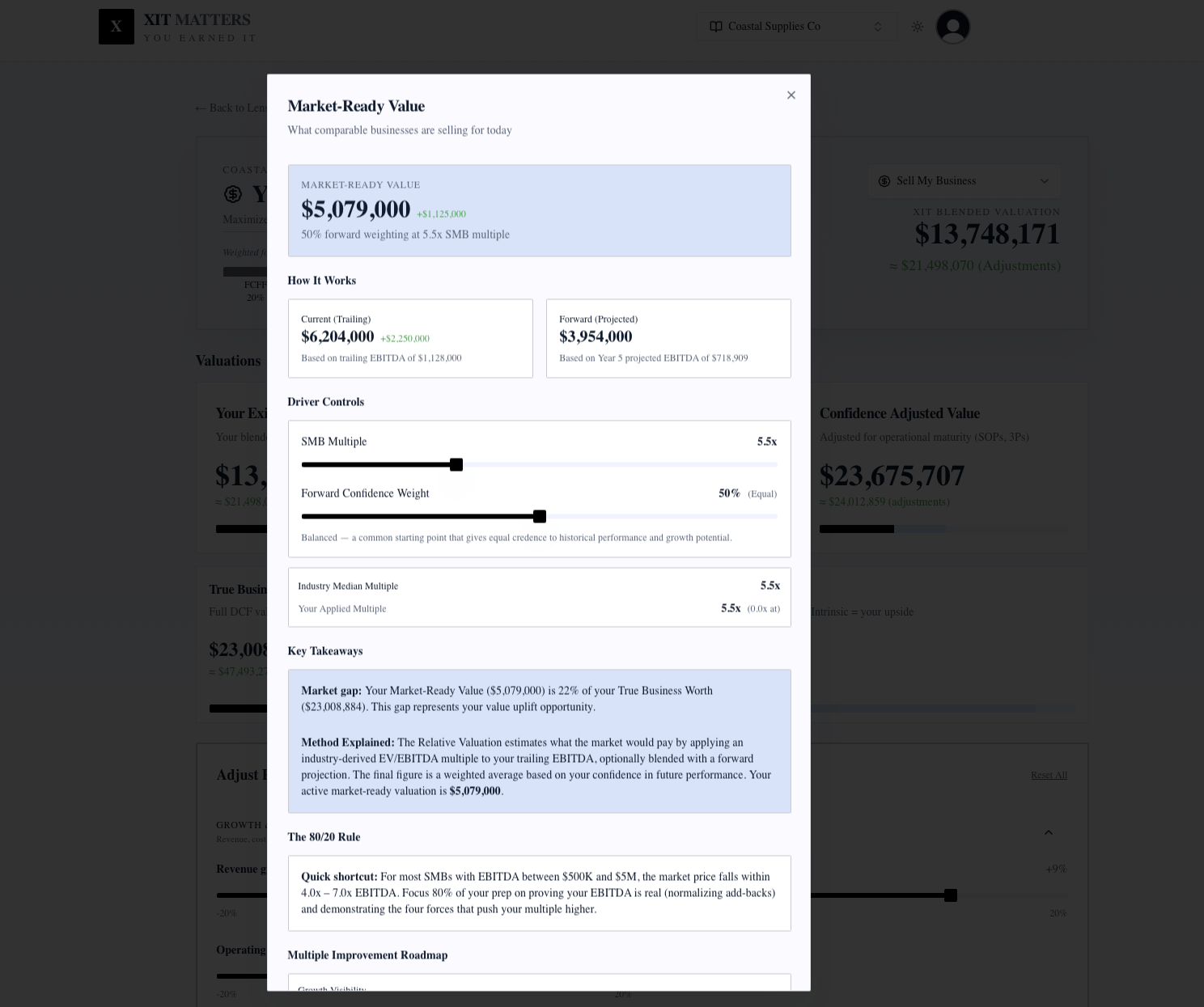
Market multiples on normalized EBITDA are the opening bid language for most SMB transactions. Your industry band — whether 2.0× to 5.5× for e-commerce, 3.0× to 9.0× for SaaS, or 2.5× to 5.0× for professional services — sets the range. Buyers then adjust for customer concentration, owner dependency, revenue quality, and working-capital pegs. The best valuation tool for business owners planning to sell shows your position on the band and which drivers compress or expand the multiple — before the buyer applies those discounts in a dark room.
FCFF — your intrinsic floor
Free Cash Flow to the Firm tells you what the operations are worth on first principles. When FCFF sits well below the EV/EBITDA answer, you may be overpriced relative to cash-generation capacity — a vulnerability in negotiation. When FCFF sits above, you have room to defend a premium. Sellers who only know the multiple miss this asymmetry entirely.
FCFE — your actual walk-away
Free Cash Flow to Equity is the number that funds your retirement, your next venture, or your earn-out survival. It accounts for debt payoff, transaction costs, tax on capital gains, and any seller note you carry. Enterprise value means nothing if FCFE after all obligations does not meet your personal threshold. The seller persona keeps FCFE visible alongside the market anchor so you never confuse the headline with the check.
The Blended View under seller weighting produces one actionable number optimized for the conversation you are about to have — while the supporting tiles keep all three lenses available for counter-arguments.
What the best valuation tool for sellers must do before you go to market
Normalize earnings for diligence. Buyers will rebuild EBITDA their way. If your normalization differs materially from theirs, the LOI price adjusts down at diligence — or the deal dies. The tool should guide owner compensation replacement, one-time item removal, and working-capital normalization before you share any number.
Quantify discount drivers. Owner dependency, customer concentration, revenue mix, and undocumented processes each compress multiples by predictable amounts. Model each driver as a slider and see the dollar impact — then fix the two largest gaps before listing.
Model deal structures. Asset sale versus stock sale, earn-out percentages, seller financing terms, and working-capital pegs all change FCFE. Pressure-test structures in the tool before accepting terms that look generous on enterprise value but thin on walk-away.
Track pre-sale improvement ROI. Hire the ops manager, convert clients to retainers, diversify the customer base — re-run the valuation quarterly and measure multiple movement. That delta is the ROI of exit prep, visible in dollars.
Switch to buyer persona for rehearsal. See exactly how a financial acquirer will underwrite your business before they do. Fix what the buyer lens exposes while you still control the timeline.
How XIT Matters serves business owners planning to sell
XIT Matters implements the Exit Matters seller workflow as software.
Activate the seller persona during setup and the Blended View over-weights EV/EBITDA while surfacing FCFF and FCFE tiles. Connect QuickBooks or Xero or enter financials manually in about ten minutes. Select your industry to load the appropriate multiple band with premium and discount drivers.
The AI Scenario Analyst handles seller-specific questions: "What if the buyer offers 4.5× EBITDA with a 20% earn-out over three years?" "What if I carry a $500K seller note at 6%?" "What if working-capital peg adds $150K to the closing adjustment?" Each scenario updates FCFE and the blended headline.
Real-Time Slider Modeling lets you drag owner-dependency, customer concentration, and recurring-revenue assumptions to simulate pre-sale improvements — then compare today's valuation to an eighteen-month optimized scenario.
Six Persona Views include seller, buyer, and investor lenses. Rehearse the buyer's perspective before negotiation. Switch back to seller for your anchor number.
Approved features — Blended Valuation Engine, AI Scenario Analyst, EV/EBITDA Market Comps, Cost of Capital Simulator, Real-Time Slider Modeling — map directly to the sell-side preparation workflow described in Exit Matters.
The eighteen-month sell-side preparation playbook
Months 1–6: Baseline and fix the biggest discounts. Run the valuation on current books. Identify the two largest compression drivers — typically owner dependency and customer concentration. Document SOPs, shift revenue toward recurring contracts, hire fractional help to reduce personal delivery hours. Re-run quarterly.
Months 7–12: Normalize and diversify. Clean owner compensation in the books. Ensure no single customer exceeds 15% of revenue. Build pipeline visibility that does not depend on your memory. Model a "market-ready" scenario and compare to baseline.
Months 13–18: Engage advisors and go to market. Hire an M&A advisor or business broker if desired. Walk in with the three-method range, one improvement scenario, and FCFE walk-away math. Use the AI Scenario Analyst during LOI negotiation to stress-test earn-outs and seller notes.
Throughout, never share a number you have not normalized yourself. Buyers respect sellers who understand the math — and exploit sellers who do not.
Negotiation tactics powered by three-method data
When a buyer anchors below your range, counter with specific drivers: "My normalized EBITDA supports median multiple because repeat revenue exceeds 40% and no customer exceeds 12% of revenue — here is the comp band and my position on it."
When an earn-out is proposed, model the probability-weighted FCFE — not the headline enterprise value. A $6M offer with 30% earn-out tied to metrics you no longer control may net less than a $5.2M all-cash deal.
When working-capital pegs surface late, you already modeled them. No surprises at the closing table.
Chapter 11 calls these "negotiation superpowers" — not tricks, but data literacy that shifts leverage to the prepared seller.
Common sell-side valuation mistakes
Waiting until burnout forces the sale. Urgency compresses multiples and invites punitive earn-out structures.
Sharing enterprise value without walk-away math. The LOI number rarely equals the check.
Skipping normalization. Diligence rebuilds EBITDA; surprises kill deals or reduce price.
Accepting the first offer because you did not know your range. Lowball LOIs are standard opening moves — counter with data.
Using a valuation from twelve months ago. Markets shift; your books shift; a living tool beats a stale report.
Ignoring tax structure. Asset versus stock sale, installment sale treatment, and state tax differences materially affect FCFE. Model them before signing.
When you still need a formal appraisal or QOE
Binding events require signed opinions: litigation, divorce, IRS estate filings, SBA lender requirements at close, and adversarial partner buyouts. A self-served three-method valuation accelerates the work and prevents lowball acceptance — but it is not the binding artifact at signing. Budget for QOE when the LOI is signed and the deal is real, not before you know whether you are selling.
Exit Matters Chapter 3 makes the economic case: spend $50K to $200K on QOE when the stakes justify it. Spend ten minutes on the self-served stack for everything leading up to that moment.
Sell-side diligence prep — what your valuation tool should surface before buyers arrive
Sophisticated acquirers rebuild EBITDA, stress-test customer concentration, and model working-capital pegs before they name a price. The best valuation tool for business owners planning to sell mirrors that diligence on your side of the table first. Run owner-compensation normalization until FCFE and EV/EBITDA tell a consistent story. Slider customer concentration from today's reality to a diversified target and save both scenarios — the delta is your pre-market improvement budget.
Document every adjustment the tool flags as low-confidence. Those flags become your CPA's diligence checklist, not surprises that kill the deal in week three. Switch to the buyer persona monthly during your prep window and note which tiles move the headline down — those are the operational fixes that return the highest dollars per hour before you list.
When the LOI arrives, re-run FCFE under the proposed structure the same day. Earn-outs, seller notes, and net-working-capital targets all change the check you deposit. A seller who models structures in hours beats a seller who discovers the gap at the closing table.
The best valuation tool for business owners planning to sell becomes indispensable when you use it to rehearse the buyer's diligence before they run it. Every month you delay that rehearsal is a month a acquirer could use discount drivers — owner dependence, customer concentration, lumpy revenue — as leverage you handed them by staying invisible on your own math.
Print your seller-weighted blended range, your FCFE walk-away, and one improvement scenario before every buyer meeting. Sellers who lead with that packet report shorter diligence cycles and fewer re-trades on price — because the math was settled before emotions entered the room. The best valuation tool for business owners planning to sell is the one you trust enough to open on your laptop while the buyer is watching. Use it to rehearse every counter-offer before you speak a number aloud. Sellers who model first negotiate second — and close faster with fewer regrets about the structure they signed.
The bottom line for owners planning to sell
The best valuation tool for business owners planning to sell weights EV/EBITDA for buyer conversations, keeps FCFF and FCFE visible for range and walk-away math, models deal structures before you sign, and tracks pre-sale improvements in dollars on a living blended headline. XIT Matters delivers that seller workflow free during beta — ten minutes to your first range, unlimited scenarios through the AI Scenario Analyst, and quarterly re-runs that measure exit prep ROI. Know your number before the buyer names theirs. Negotiate from data, not hope.