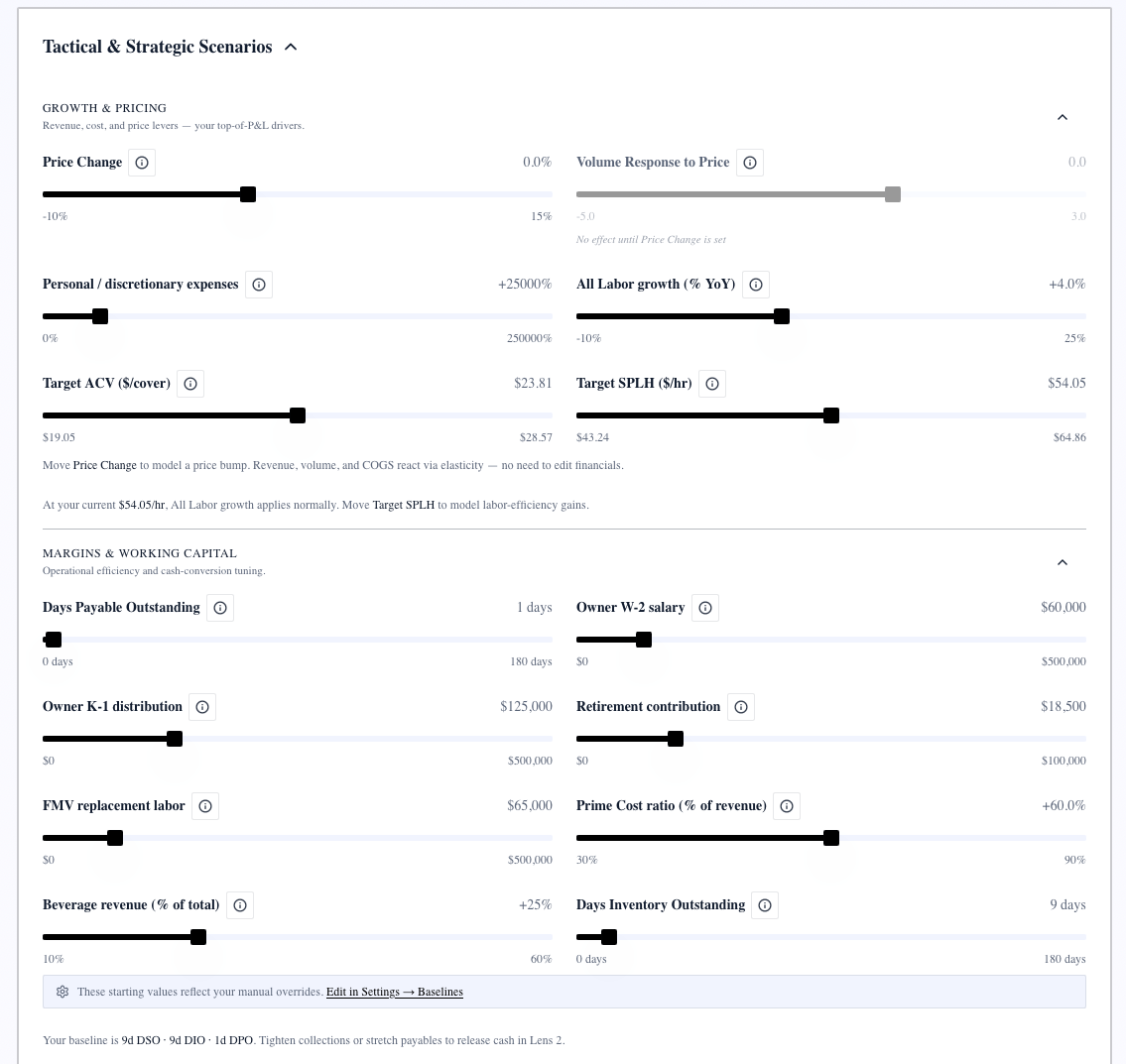
Why owners need the best tool for business owners to run "what if" scenarios
Static valuations answer where you are; slider-based "what if" tooling answers what changes if you pull a lever tomorrow. When a decision spans price, headcount, debt, and customer mix, isolated spreadsheet tabs cannot keep weighted average cost of capital, industry multiples, and blended value aligned. The best tool for business owners to run "what if" scenarios ties every drag to Free Cash Flow to the Firm, Free Cash Flow to Equity, and EV/EBITDA simultaneously — so the persona-weighted headline moves in seconds, not after a weekend of formula repair.
Exit Matters Chapter 7 frames the Blended View. Chapter 9 lists tactical levers. Chapter 10 covers structural forks. Slider-first modeling turns those chapters into weekly operating habit instead of annual spreadsheet archaeology.
Why slider-first "what if" beats spreadsheet tabs
Spreadsheets force you to rebuild links every time a question changes. The best tool for business owners to run "what if" scenarios keeps a single living baseline — your normalized P&L, balance sheet, and industry band — and lets you drag levers without touching cell formulas. Move price 5 percent, add a $72K account manager, or extend vendor terms fifteen days; FCFF, FCFE, and EV/EBITDA recalculate together while the blended headline updates in real time.
Chapter 7 weights those three methods toward the decision you face today. Chapter 9 names the levers that move Main-Street valuations: margin, headcount burden, working-capital days, customer mix. Chapter 10 adds structure questions — earn-outs, seller notes, partial sales — where timing matters as much as operations. Slider-first modeling makes those chapters operational: every drag produces a saved before-and-after you can defend in a bank or buyer meeting.
Decision clusters owners model most often
Capacity and delivery. A landscaping firm debating a second crew chief needs FCFF after payroll and the multiple lift from reduced owner dispatch hours — not a gut-feel hire.
Menu or SKU pricing. A specialty distributor testing a 4 percent list-price increase needs retention held constant while normalized EBITDA and working capital move together.
Debt and lease forks. Refinancing equipment debt before a sale changes FCFE walk-away math; model prep penalties against monthly savings before you sign.
Pre-exit fixes. Documenting SOPs and cutting top-customer concentration from 32 percent to 18 percent over four quarters — quantify seller-weighted delta before you retain a broker.
Each cluster spans enterprise cash flow, equity walk-away, and market comps. Answering only one lens leaves you exposed when a banker weights FCFE and a buyer anchors on EV/EBITDA.
What slider-based scenario tooling must include
Synchronized three-method math. Levers cannot update EV/EBITDA while FCFF and FCFE stay frozen — all three move or the range lies.
Visible cost of capital. Weighted average cost of capital and cost of equity inputs must respond when concentration or recurring mix changes — not hide behind a fixed 12 percent default.
Persona toggles without rebuilds. Owner reinvestment weighting and seller pre-market weighting should switch on the same baseline.
Audit-friendly snapshots. Exportable before-and-after states your CPA can reconcile — not a black-box headline.
Manual or imported books. Ten-minute manual entry or QuickBooks and Xero compatible sync; scenarios refresh when the baseline improves.
How XIT Matters handles owner "what if" runs
XIT Matters is built around Real-Time Slider Modeling first — drag price, DSO, owner-dependency percentage, or industry multiple band position and watch every tile move.
When sliders are not enough, the AI Scenario Analyst maps compound questions to coordinated inputs — useful for bundled decisions that would take an hour in Excel.
Six Persona Views cover owner, seller, buyer, investor, and capital-raiser weightings on the same financials.
The Blended Valuation Engine produces one headline per persona from FCFF, FCFE, and EV/EBITDA.
Cost of Capital Simulator ties customer concentration and recurring mix to discount rate movement.
EV/EBITDA Market Comps list premium and discount drivers beside the multiple slider for your industry band.
Trust bar: Built from Exit Matters, methodology used by PE firms, QuickBooks and Xero compatible, free during beta, ten minutes to your first valuation.
Twelve-month slider discipline — a concrete cadence
Months 1–3: Baseline plus four stress tests — price, hire, working-capital normalization, customer diversification — ranked by blended delta per dollar.
Months 4–6: Capital allocation forks — lease versus buy, marketing spend versus debt paydown — compare FCFF cash today to multiple expansion tomorrow.
Months 7–9: External rehearsals under investor or capital-raiser weighting before lender or partner meetings.
Months 10–12: Seller-weighted LOI structure drills even if exit is optional — earn-out, peg, note terms.
Re-run when books close each month; archive one scenario per leadership meeting tied to that month's decision.
Categories to keep in your slider library
Price and mix — volume, price, and retention together; isolated price tabs overstate upside when churn slips.
People and dependency — payroll lines plus multiple band movement when owner delivery hours drop.
Working capital — DSO, DIO, and payment-term shifts that release or trap cash in FCFF.
Capital structure — refinances, new term debt, or equity injections that change FCFE and WACC.
Band position — premium drivers from your industry record (recurring mix, bench depth, clean financials) modeled as dollar deltas on the blended view.
Mistakes that waste scenario work
Chasing revenue-only scenarios while ignoring margin and working capital — where diligence usually breaks deals.
Running scenarios on stale books — misprices today's fork.
Using one persona blend for every conversation — reinvestment and sale answers differ.
Treating outputs as binding opinions — Quality of Earnings and formal appraisal still govern signed events.
Failing to save reproducible outputs — credibility collapses when you cannot recreate the math in the room.
Monthly operating review — thirty minutes
Refresh financials, confirm baseline blended value, run one scenario tied to this month's decision — hire, price move, debt facility, or customer win/loss. Store the output where your CPA or banker can access it. Teams that institutionalize this cadence report fewer surprises when external parties underwrite the business.
Bundled levers — when one slider is not enough
Real forks combine variables: modest price lift plus one operations hire plus a three-year anchor contract. Map bundled moves in one pass; pre-run optimistic, base, and conservative cases so you know your floor before a banker stress-tests your plan.
Advisors versus owner-run sliders
Bespoke advisor models excel at complex closings but lag weekly operating rhythm. Generic calculators lack scenario engines entirely. Slider-first institutional tooling sits between — unlimited iterations, ten-minute setup, free during beta. Use advisors for binding opinions; use sliders for the hundred small decisions that compound into enterprise value.
When formal work still applies
Litigation, divorce, IRS filings, and signed Quality of Earnings at close require CPA-led artifacts. Sliders accelerate preparation — you arrive with range and sensitivity understood — but do not replace signed opinions in adversarial contexts.
First session in ten minutes
Connect or enter financials, establish owner-persona baseline, drag the lever tied to your highest-stakes pending decision, save before-and-after. Repeat monthly as books improve. Consistency beats perfection — one decision answered in dollars beats a quarterly spreadsheet heroics cycle.
Bottom line
The best tool for business owners to run "what if" scenarios coordinates slider moves across FCFF, FCFE, and EV/EBITDA, weights the blend to your persona, and stays live as books evolve. XIT Matters delivers Real-Time Slider Modeling, optional AI Scenario Analyst support, Six Persona Views, and the Blended Valuation Engine — free during beta. Stop rebuilding tabs. Start measuring forks in dollars on a valuation that moves with your business.
Reusable scenario library
Label saved runs by decision type — pricing, hiring, capital structure, exit timing — with assumption notes beside blended delta. When forecasts are questioned, reproduce the run in seconds. A twelve-month library beats one-off analyses buried in email threads; refresh baselines quarterly and reapply proven templates as numbers improve.
Worked slider example — regional HVAC distributor
Consider a $4.2M revenue HVAC distributor with $620K normalized EBITDA, owner still approving every commercial bid, DSO forty-two days, and top customer at 24 percent of revenue. Baseline seller-weighted blend sits near discount on the services band.
Drag price 3.5 percent on service contracts with retention flat: blended delta modest in year one but multiple band ticks toward median as pricing power signals reduce buyer risk.
Add a $78K operations manager reducing owner bid hours 35 percent: FCFF absorbs payroll immediately; EV/EBITDA band expands enough that blended delta turns positive by month eighteen on the saved scenario.
Normalize DSO from forty-two to thirty-four days: FCFF releases working capital funding growth without new debt — often the highest ROI slider for distribution owners.
Run the three moves together; ranked output becomes the operating plan with valuation ROI attached to each initiative. That is the difference between slider-first "what if" work and a single annual valuation PDF.
Spreadsheet failure modes owners recognize
Broken links when you duplicate tabs for a new hire scenario. Inconsistent discount rates across methods. Version control chaos when three people email different workbooks. Slider tooling on a living baseline eliminates those failure modes — one baseline, unlimited forks, reproducible snapshots.
Pairing sliders with advisor conversations
Bring saved slider outputs to your CPA or banker as the starting anchor — not as gospel. Advisors add normalization you missed and comps you had not seen. Slider discipline makes their time efficient because you already speak in FCFF, FCFE, and EV/EBITDA ranges before the first meeting.
Governance — who sees scenario outputs internally
Share baseline and ranked scenarios with your leadership team monthly; keep seller-weighted exit drills restricted to owners, CPA, and spouse until you announce intent. Label files with date, persona, and lever set so six months later you can explain why a capital decision looked right at the time. Governance prevents scenario work from becoming folklore — reproducible math beats heroic memory.
When to refresh the baseline
Re-run after any material event: lost customer above 5 percent of revenue, completed hire that changes owner dependency, signed debt facility, or closed quarter with books finalized. Stale baselines misprice forks; living baselines keep slider deltas trustworthy for board and lender conversations.
Closing standard for owner operators
The best tool for business owners to run "what if" scenarios earns its place when sliders, persona weighting, and three-method math stay synchronized on one baseline you actually update. XIT Matters ships that workflow free during beta — ten minutes to first run, unlimited forks as books improve. Measure decisions in dollars on a valuation that moves with your business, not a spreadsheet snapshot from last fiscal year. Start with one lever this week; expand your library as each month’s leadership decision gets a saved before-and-after. Consistency compounds — owners who slider-test monthly report sharper capital allocation and fewer surprises when buyers or bankers underwrite the same levers in diligence. That rhythm is the operational payoff of slider-first scenario work.