Why consultants need the best business valuation app — not another Excel template
If you are evaluating the best business valuation app for consultants, you serve clients who expect institutional rigor without institutional timelines. Boutique strategy firms, management consulting practices, and professional advisory shops transact in a multiple band that punishes founder dependency and rewards repeatable IP — yet most free calculators apply a generic services multiple and ignore whether revenue is retainer-based or project-lumpy. The best business valuation app for consultants runs FCFF, FCFE, and EV/EBITDA on normalized consulting financials, anchors to the consulting industry band (2.5× low, 3.8× median, 5.5× high on trailing EBITDA), and lets you iterate scenarios in front of a client without rebuilding a fragile spreadsheet.
Exit Matters Chapter 6 explains what buyers pay for in professional services: visibility of future cash flows, low key-person risk, and revenue that survives the founder's departure. Chapter 7 blends the three lenses so advisors can show range and convergence — not a single number pulled from a broker's napkin. Consultants who advise on value must model the same mechanics buyers use in diligence; an app that skips FCFF or FCFE leaves you defending half an analysis.
The consulting valuation landscape — multiples, drivers, and typical deal size
Consulting firms in the typical SMB band — $500K to $15M revenue — trade on trailing twelve-month EBITDA multiplied by industry-specific comps before net debt adjustment.
Low end (2.5× EBITDA) applies to hours-billed staff augmentation, founder-led delivery, and project mix without renewals. Buyers treat these as job shops, not durable enterprises.
Median (3.8× EBITDA) fits firms with mixed retainer and project revenue, some bench depth beyond the founder, and multi-year client relationships on a portion of the book.
High end (5.5× EBITDA) rewards repeatable methodology or IP, renewals that survive leadership change, and delivery teams that operate without the founder on every engagement. Boutique strategy and management-consulting firms with clean financials can clear 5×; pure staff-aug shops compress toward 2.5×–3.0×.
Premium drivers include repeatable IP or methodology, multi-year client relationships, and bench depth beyond the founder. Discount drivers include hours-billed models, founder-led delivery, and project mix without renewals. The best business valuation app for consultants surfaces these drivers beside the slider so clients understand position on the band — not just the multiple itself.
Three methods every consulting engagement should run
FCFF — intrinsic value of the practice. Normalized EBITDA minus taxes, reinvestment, and working-capital needs, discounted at WACC. Consulting working capital is usually lighter than product businesses, but DSO on large client invoices still matters.
FCFE — what the equity holder receives. After debt service and reinvestment, FCFE answers partner buyout and personal wealth questions — often the number clients care about more than enterprise value.
EV/EBITDA — market anchor. Strategic acquirers and PE roll-ups in professional services speak multiples. Seller-weighted blends prioritize this lens; owner-weighted blends keep all three visible for advisory work.
The Blended View under agency-owner persona weighting produces one headline optimized for consultants advising peers or valuing their own firms — while tiles keep FCFF and FCFE available for partner disputes and succession planning.
What the best business valuation app for consultants must deliver
Consulting-specific multiple band with premium and discount drivers listed — not a generic "professional services" guess.
Normalization workflow for owner compensation above market, personal expenses, and one-time project costs that distort EBITDA.
Owner-dependency and retainer sliders tied to multiple expansion — the two levers that move consulting valuations most.
AI Scenario Analyst for client questions: "What if we productized our methodology and shifted 40% of revenue to subscriptions?" "What if we hired two senior managers and I exited delivery?"
Persona switching for seller, buyer, and investor conversations without duplicating models.
Client-session speed — first range in ten minutes, unlimited iterations during a meeting.
Defensible methodology link to Exit Matters and the platform methodology page for clients who ask how the engine works.
How XIT Matters serves consultants and their clients
XIT Matters implements the Exit Matters professional-services workflow as software.
Select consulting as the industry to load the 2.5×–5.5× band with typical revenue range $500K–$15M and notes on boutique strategy versus staff-aug compression.
Connect QuickBooks or Xero compatible data or enter financials manually. Normalize owner compensation and non-recurring project revenue in the worksheet before running methods.
The AI Scenario Analyst handles consulting-specific questions — retainer mix, bench build-out, client concentration, methodology productization — and recalculates FCFF, FCFE, EV/EBITDA together.
Six Persona Views let you show a client how a buyer versus a seller versus an investor would weight the same numbers — powerful in partner buyout and succession engagements.
Real-Time Slider Modeling supports live working sessions: drag customer concentration from 35% to 15% and show multiple expansion in real time.
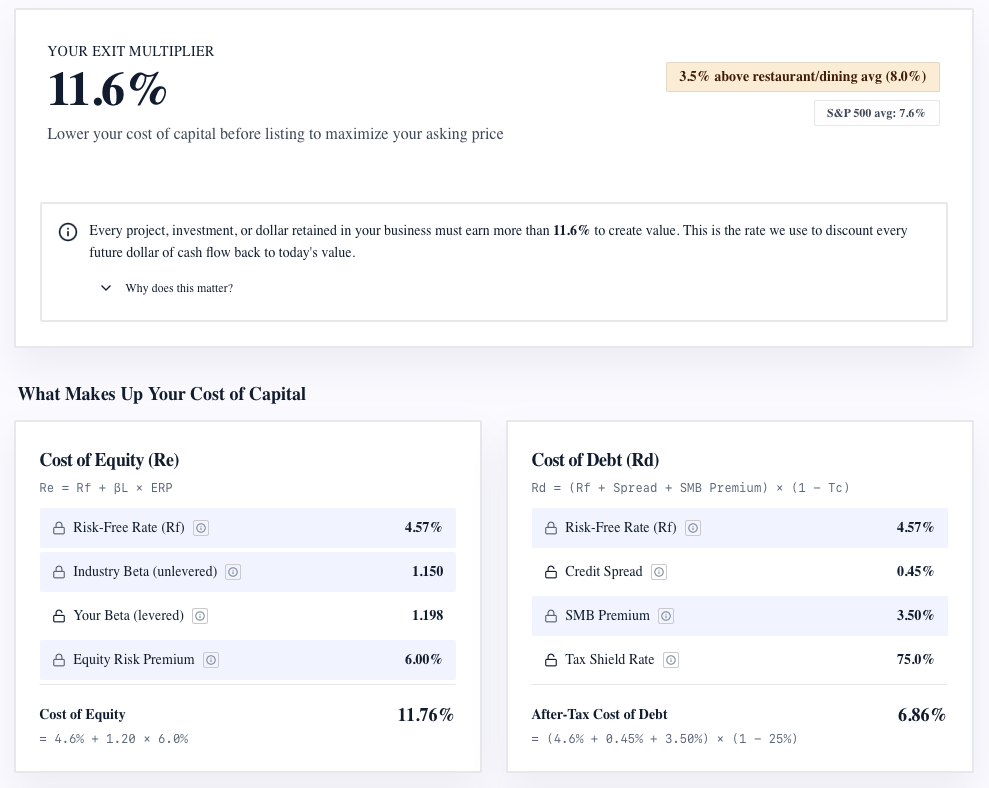
Cost of Capital Simulator exposes WACC drivers when client risk profile — concentration, recurring mix — affects the discount rate in FCFF.
Approved features — Blended Valuation Engine, AI Scenario Analyst, EV/EBITDA Market Comps, Cost of Capital Simulator, Real-Time Slider Modeling, Six Persona Views — map to the consulting advisory workflow without inventing capabilities outside the approved grid.
Advisory use cases — how consultants deploy the app
Succession and partner buyout. Model FCFE for departing partners under multiple structures; show how fixing founder dependency over twenty-four months changes the buyout price.
Pre-sale preparation. Rank operational fixes by blended delta — retainer conversion, IP documentation, senior hires — before engaging a broker.
Growth and capital planning. Owner clients weighing debt versus equity see FCFF and FCFE impacts side by side with market multiples.
Dispute avoidance. When partners disagree on value, a three-method range with documented assumptions beats arguing from revenue multiples alone.
Client education. Teach owners the same lenses buyers use — elevates advisory relationships and reduces surprise in eventual transactions.
Common consulting valuation mistakes the app helps prevent
Using revenue multiples for firms with thin margins. EBITDA normalization matters; revenue multiples overstate value when delivery cost is high.
Ignoring founder dependency. Clients assume goodwill covers personal brand; buyers discount heavily.
Treating all consulting firms alike. Strategy boutiques and staff-aug shops do not share the same band position.
Static Excel models that break when assumptions change mid-meeting. Living recalculation keeps client sessions credible.
Skipping FCFE in partner disputes. Enterprise value without walk-away math causes unfair buyout terms.
Running client workshops with the best business valuation app for consultants
Structure advisory sessions in three passes for credibility and speed. Pass one: connect client financials and normalize EBITDA together — transparency builds trust before any number appears. Pass two: run baseline FCFF, FCFE, and EV/EBITDA and walk through band position using consulting premium and discount drivers listed beside the slider. Pass three: open AI Scenario Analyst for the client's top two strategic questions — retainer conversion, senior hire, methodology productization — and save before-and-after snapshots they take with them.
Consultants report that live slider sessions close follow-on engagements faster than static PDF deliverables because clients see dollar impact immediately. When a client asks whether to hire a practice manager, drag owner-dependency down and show multiple expansion alongside FCFF absorption of the salary — the ROI argument makes itself.
For multi-partner firms, run separate FCFE scenarios under each buyout structure before partners enter negotiation. Enterprise value arguments destroy relationships when walk-away math differs by six figures because note terms were never modeled. The best business valuation app for consultants keeps those structures in one living model instead of five conflicting Excel tabs.
Consulting firm types and where they land on the band
Strategy and management-consulting boutiques with repeatable frameworks and enterprise clients often approach the 4.5×–5.5× tier when bench depth supports delivery without the founder. IT consulting and implementation shops with project revenue may sit at 2.5×–3.5× unless they have managed services or recurring support contracts. HR and executive coaching practices trade on client retention and productized assessments — model those drivers explicitly rather than applying a generic professional-services label.
Staff augmentation and body-shop models compress toward the low end regardless of revenue scale because buyers see no transferable enterprise — only billable hours tied to individuals. Use the app to show clients why investing in IP and retainer conversion is an exit-multiple strategy, not just an operational preference.
Integrating valuation into recurring advisory retainers
Forward-thinking consultants bundle quarterly valuation re-runs into CFO-advisory or succession-planning retainers. Each quarter: refresh financials, re-run baseline, test one scenario tied to the client's operating plan, archive snapshot. Clients receive measurable progress on value drivers — concentration, recurring mix, owner hours — instead of vague "we'll grow into a premium multiple someday" advice.
The app supports this rhythm because setup is ten minutes per refresh, not a new engagement each time. Your advisory firm differentiates on institutional methodology without hiring a valuation associate for every client touchpoint.
When consultants still need formal appraisal
Binding partner buyouts under dispute, litigation, IRS filings, and lender-required opinions at close still need CPA-signed deliverables. The best business valuation app for consultants accelerates the work — clients arrive with ranges and scenario priorities — but does not replace signed fairness opinions in adversarial contexts. Use the app for 80 percent of engagements; escalate to formal appraisal when stakes are binding.
Preparing consulting clients for buyer diligence
Buyers of consulting firms request the same artifacts in every deal: trailing three-year P&L with normalized EBITDA bridge, client concentration schedule, retainer versus project revenue breakdown, org chart with billable utilization, and evidence that methodology survives without the founder. The best business valuation app for consultants surfaces those drivers before diligence begins. Run customer concentration sliders with your client in the room. Model owner-dependency reduction with a named hire scenario. Export snapshots that become the diligence prep packet your client sends to advisors — not a surprise rebuild when the LOI arrives.
Consultants who front-load this work report smoother transactions because discount drivers were fixed or priced before term sheets, not discovered in week two of data room review. Your advisory value rises when clients see you as the partner who quantified exit readiness, not the advisor who only commented on narrative decks. Save every scenario snapshot in a client folder so year-two advisory renewals start from documented progress on value drivers instead of a blank spreadsheet rebuild. That discipline turns the best business valuation app for consultants into a retention tool — clients stay because they see measurable enterprise value movement quarter over quarter.
The bottom line for consultants
The best business valuation app for consultants combines consulting-specific multiples (2.5×–5.5× EBITDA), three-method institutional rigor, AI scenario planning, and persona-aware blends in a client-session-friendly workflow — ten minutes to first range, unlimited scenarios, free during beta. XIT Matters gives boutique advisors and consulting firm owners the same FCFF, FCFE, and EV/EBITDA stack PE buyers underwrite, with premium and discount drivers visible beside every slider. Stop rebuilding spreadsheets for every engagement. Start delivering defensible ranges your clients can act on.