Why business owners need the best AI scenario planning tool — not another spreadsheet
If you are searching for the best AI scenario planning tool for business owners, you already know spreadsheets fail the moment a question spans price, people, and capital structure at once. You might model a 10 percent price increase in one tab, a new hire in another, and a debt paydown in a third — but none of those tabs talk to your cost of capital, your industry multiple, or the blended number that actually drives whether you sell, borrow, or reinvest. The best AI scenario planning tool for business owners closes that gap: you ask a plain-English question, the engine moves the right levers across FCFF, FCFE, and EV/EBITDA, and you see exact dollar impact on the persona-weighted headline in seconds.
Exit Matters Chapter 7 introduces the Blended View — three institutional methods weighted toward the decision in front of you. Chapter 9 covers tactical levers owners pull every quarter: pricing, headcount, working capital, customer mix. Chapter 10 expands into strategic scenarios — acquisition, recap, partial sale — where timing and structure matter as much as operations. Scenario planning without all three lenses is theater. Scenario planning with them is how prepared owners negotiate, allocate capital, and sleep before a buyer diligence call.
The owner scenario-planning problem — one question, three methods, one answer
Most owners face scenario questions in clusters, not isolation.
Growth and reinvestment. Should you hire the director of operations now or wait until revenue crosses $3M? What does each path do to FCFF after the salary burden and the multiple expansion from reduced owner dependency?
Pricing and margin. Can you raise prices 7 percent without losing more than 2 percent of volume? How does that flow through normalized EBITDA, working capital, and the EV/EBITDA band?
Exit timing. If you fix customer concentration and document delivery SOPs over eighteen months, what is the delta on seller-weighted FCFE versus selling today under fatigue?
Capital structure. If you refinance high-cost debt before a sale, does FCFE improve enough to justify the prep penalty?
Each question touches cash flow to the firm, cash flow to equity, and what the market pays — the three lenses professional valuators blend. A tool that answers only one lens leaves you arguing from weakness when a banker weights FCFE and a buyer anchors on EV/EBITDA.
What the best AI scenario planning tool must do
Plain-English input. You should not need to know which cell controls beta or terminal growth. Ask "What if I raised prices 8% and churn stayed flat?" and let the engine map to revenue, gross margin, and retention assumptions.
Simultaneous three-method recalculation. FCFF, FCFE, and EV/EBITDA must update together. If a hire reduces owner dependency, the multiple band should expand while FCFF absorbs the salary — both effects visible on one screen.
Persona-aware blending. Active owners weight reinvestment and wealth tracking differently than sellers prepping a LOI. The best AI scenario planning tool for business owners switches persona weightings without rebuilding the model.
Slider and AI hybrid. Drag price, working-capital days, or customer concentration manually; use the AI Scenario Analyst for compound questions that would take an hour in Excel.
Living baseline. Scenarios mean nothing if the starting model is stale. Connect QuickBooks or Xero compatible data or enter financials manually; re-run scenarios quarterly as books improve.
Audit trail for advisors. Save before-and-after snapshots you can share with a CPA, banker, or board member — methodology visible, not a black-box guess.
How XIT Matters delivers AI scenario planning for owners
XIT Matters implements the Exit Matters scenario workflow as software.
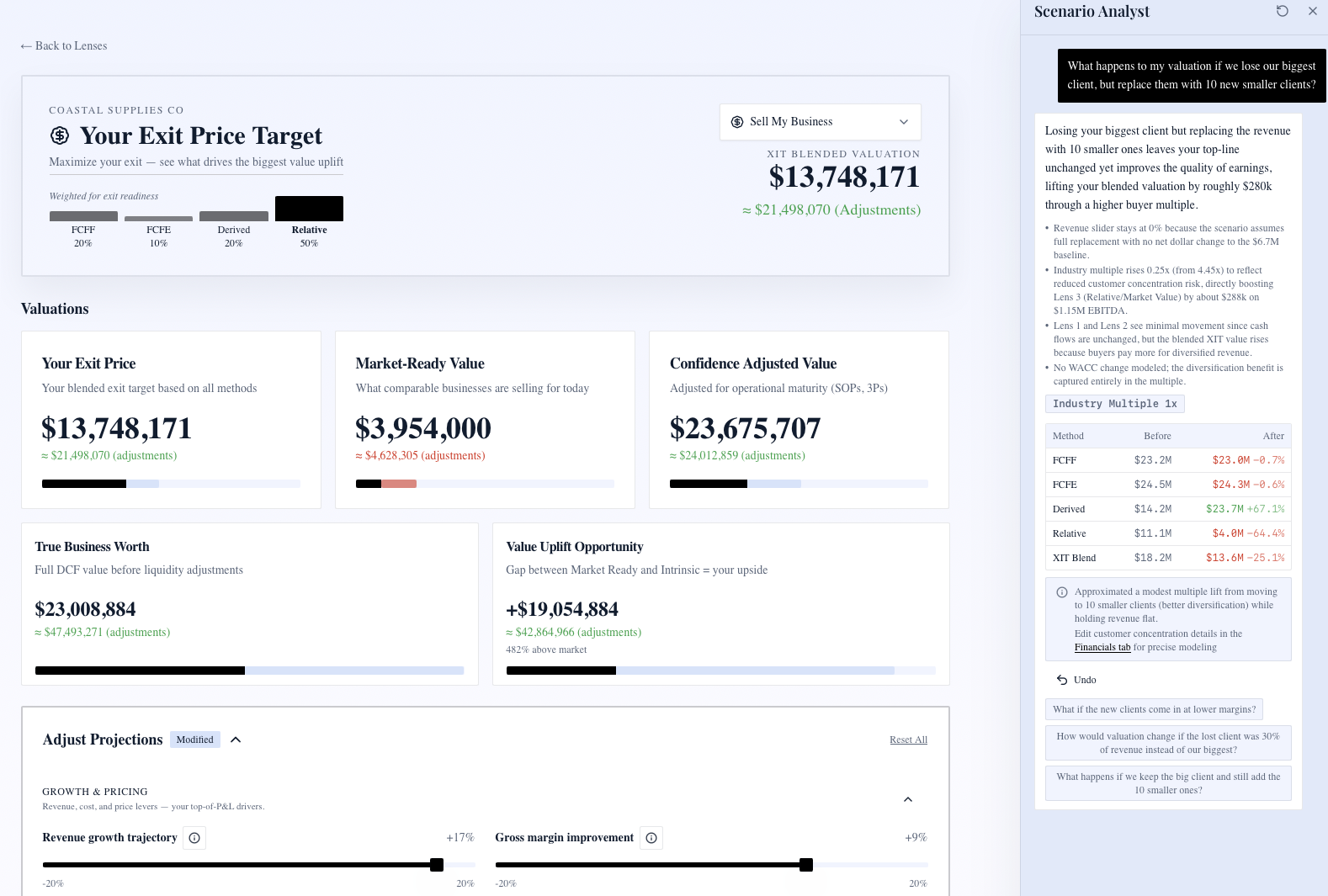
The AI Scenario Analyst accepts questions like "What if I added a $120K operations manager and reduced my delivery hours by 30%?" or "What if I extended payment terms and DSO rose fifteen days?" Each maps to revenue, opex, working capital, and owner-dependency sliders, then recalculates all three methods.
Real-Time Slider Modeling lets you drag individual levers and watch the blended headline move instantly — useful when you already know which input to stress-test.
Six Persona Views include owner, seller, buyer, investor, and capital-raiser lenses. Model a reinvestment decision under owner weighting, then flip to seller to see how the same operational fix affects exit value.
The Blended Valuation Engine combines FCFF, FCFE, and EV/EBITDA into one actionable number per persona — the anchor for every scenario comparison.
Cost of Capital Simulator exposes WACC drivers so scenario changes that affect risk — customer concentration, recurring revenue mix — flow through the discount rate, not just the multiple.
EV/EBITDA Market Comps anchor scenarios to real SMB transaction multiples for your industry band, with premium and discount drivers listed beside the slider.
Approved trust claims apply throughout: Built from Exit Matters, methodology used by PE firms, QuickBooks and Xero compatible, free during beta, ten minutes to your first valuation.
A practical owner scenario playbook — twelve months of what-if discipline
Quarter 1: Baseline and the big four. Run your first valuation. Test price increase, one hire, working-capital normalization, and customer diversification. Rank scenarios by blended delta per dollar of investment.
Quarter 2: Capital allocation. Model equipment versus lease, debt paydown versus growth marketing, and owner compensation normalization. Compare FCFF impact to multiple impact — some fixes help cash flow without moving the headline; others move the multiple without near-term cash.
Quarter 3: External conversations. Rehearse banker and investor scenarios under capital-raiser or investor persona weighting. Bring saved outputs to meetings; update assumptions live if they push back on growth or margin.
Quarter 4: Optional exit rehearsal. Switch to seller persona. Model LOI structures — earn-out, seller note, working-capital peg — even if you are not selling yet. Knowing walk-away math early prevents bad decisions later.
Throughout, treat scenario planning as operating rhythm, not a one-time exercise. Owners who re-run scenarios quarterly report sharper capital decisions and fewer surprises when external parties underwrite the business.
Scenario categories every owner should master
Revenue and pricing scenarios. Volume, price, mix, and churn interact. Model them together; isolated price tabs overstate impact when retention slips.
People and owner dependency. Every hour you remain the primary rainmaker or delivery lead compresses multiples. Scenario hiring, delegation, and documented SOPs — quantify the multiple expansion, not just the payroll line.
Working capital and cash conversion. DSO, DIO, and DPO changes affect FCFF immediately and signal quality of earnings to buyers. A scenario that releases cash from working capital can fund growth without new debt.
Capital structure and cost of capital. Refinancing, new equipment debt, or equity injection shifts FCFE and WACC. Model before you sign loan docs.
Industry and multiple band position. Move from discount to median on your industry band by fixing listed premium drivers — recurring revenue, bench depth, clean financials — and measure each fix in dollars on the blended view.
Common scenario-planning mistakes owners make
Modeling only revenue. Top-line scenarios ignore margin, working capital, and multiple effects — the three places deals die in diligence.
Using stale financials. A scenario built on last year's books misprices today's decision.
Ignoring persona weighting. The right answer for reinvestment differs from the right answer for sale; one blend does not fit all conversations.
Treating AI output as binding. Scenario planning informs decisions; QOE and formal appraisal still govern binding events.
Never saving outputs. Scenarios you cannot reproduce in a meeting with a banker or buyer lose credibility instantly.
Integrating scenario planning into your monthly operating review
Add thirty minutes to your monthly leadership meeting: refresh financials, confirm baseline blended value, review one scenario tied to this month's strategic decision. If the decision is a hire, run the hire scenario. If it is a price change, run pricing. If it is a new debt facility, run capital structure. Archive the output in a shared folder your CPA, banker, or board member can access — consistency beats heroic quarterly spreadsheet rebuilds.
Owners who institutionalize this habit report faster capital decisions because the valuation impact is pre-computed before the conversation, not debated from intuition in the room. The best AI scenario planning tool for business owners becomes part of operating rhythm, not a one-time curiosity when a buyer calls.
Compound scenarios — when one lever is not enough
Real decisions rarely move one variable. "Raise prices 6 percent, hire an ops manager, and extend one enterprise contract to a three-year retainer" spans revenue, opex, retention, and multiple band position simultaneously. Compound questions are where spreadsheets break and AI scenario planning earns its place — map the question to coordinated lever moves, recalculate FCFF, FCFE, and EV/EBITDA together, and compare to baseline in one pass.
Test optimistic, base, and conservative assumptions for the same compound scenario. Buyers and bankers will stress-test your plan; pre-run the downside case so you know your floor before they ask.
AI scenario planning versus traditional advisory models
Traditional advisors build bespoke models over weeks and charge for each revision. That works for complex transactions but fails the weekly operating rhythm owners need. Generic calculators offer no scenario engine at all. The best AI scenario planning tool for business owners sits in the middle: institutional methodology, unlimited scenario iterations, ten-minute setup, free during beta. Use advisors for binding opinions and negotiation strategy; use AI scenario planning for the hundred small decisions that compound into enterprise value.
When you still need formal modeling beyond AI scenarios
Litigation, divorce, IRS filings, and signed QOE at close require CPA-led artifacts. AI scenario planning accelerates preparation — you arrive knowing your range and your lever sensitivity — but does not replace signed opinions in adversarial or binding contexts. Budget formal work when the stakes justify it; run AI scenarios for everything leading up to that moment.
Getting started with AI scenario planning in ten minutes
Connect QuickBooks or Xero compatible data or enter financials manually. Run your baseline valuation under owner persona. Ask the AI Scenario Analyst your highest-stakes question from the last quarter — pricing, hiring, debt, or customer mix. Save the output and label it baseline-plus-one. That first scenario becomes the template for your monthly operating review: refresh numbers, re-run, compare delta month over month. The best AI scenario planning tool for business owners rewards consistency over perfection. Start with one question answered in dollars, then expand your playbook as books improve and your team learns to think in blended valuation impact instead of isolated spreadsheet tabs.
The bottom line for business owners
The best AI scenario planning tool for business owners turns plain-English questions into precise moves across FCFF, FCFE, and EV/EBITDA, recalculates all three methods simultaneously, and weights the blend toward the persona that matches your decision — reinvestment, sale, or capital raise. XIT Matters delivers that workflow with the AI Scenario Analyst, Real-Time Slider Modeling, Six Persona Views, and the Blended Valuation Engine — free during beta, ten minutes to your first baseline, unlimited scenarios as your books evolve. Stop guessing in spreadsheets. Start measuring every major decision in dollars on a living valuation.